For decades, one of the most powerful weapons in television advertising was something called the roadblock. A brand did not simply buy an advert. It bought every advert in the commercial break. On a specific programme, at a specific time, nobody else had a chance to speak. For those ninety seconds, the brand completely owned the viewer's attention.
That was the magic of linear television.
Programmatic advertising has transformed the industry. It has given brands incredible scale, automation and precision, allowing campaigns to reach audiences across thousands of publishers, apps and devices. Yet for all its sophistication, programmatic has never truly recreated the one thing that made television launches feel so dominant. A campaign can reach millions of viewers and still never own a single moment.
That is beginning to change.
Most programmatic buying still treats an ad pod as a collection of impressions. Win the auction and your advert appears somewhere within the commercial break. It could be first, second or last. For most campaigns, the position is simply whatever happens to be available.
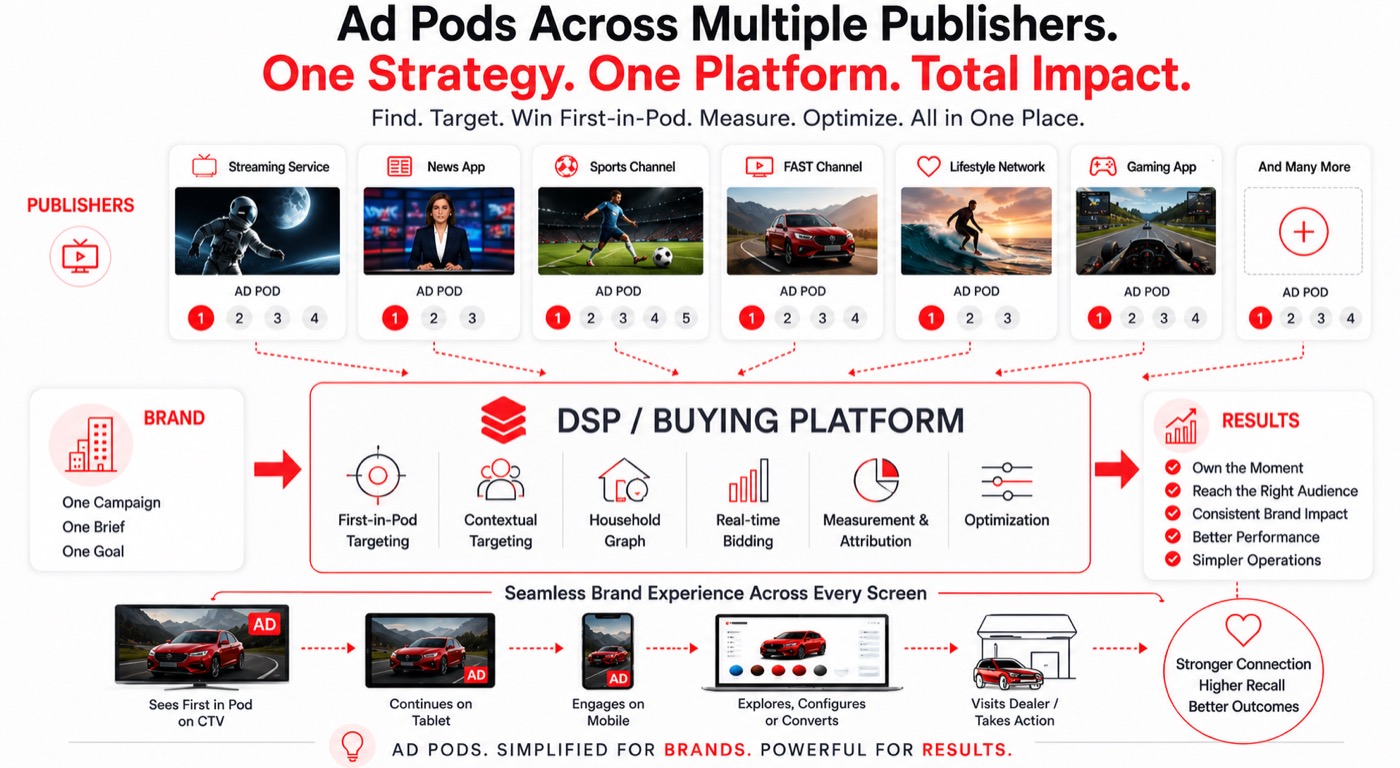
Some streaming platforms now expose pod position as a signal that buyers can target, using the slotinpod field introduced in OpenRTB 2.6, through which a seller signals that it can guarantee delivery against a specific slot in the pod. The permitted values — first, last or any position — are enumerated in AdCOM 1.0. Instead of buying any impression within the pod, advertisers can secure the very first position in every commercial break across selected publishers and content. It may sound like a subtle difference, but commercially it changes everything. For the first time, programmatic begins to recreate the television roadblock.
Imagine a car manufacturer launching its latest electric vehicle. The objective is not simply to reach adults watching television at nine o'clock. The objective is to own nine o'clock. The campaign is built around motorsport, automotive reviews, premium sports and adventure programming. Every commercial break begins with the same brand. Every viewer encounters the same message before anyone else.
The conversation with the marketing team suddenly changes. Instead of saying, "We reached our audience," the campaign can confidently say, "We owned the most valuable moment of our audience's viewing experience." That is a very different promise.
Where programmatic truly separates itself from linear television is what happens next. A traditional television roadblock ended when the commercial break ended. A programmatic roadblock does not have to. The same household that watched the advert on television may pick up a phone or tablet a few minutes later. Rather than showing the same advert again, the campaign continues the story. The television commercial introduces the new vehicle. The mobile phone opens an interactive configurator. The tablet shows a longer product film. The laptop offers a finance calculator, a dealer locator or a booking experience. Each screen has a purpose, and every interaction builds naturally on the one before it.
This is something linear television could never achieve. Television was brilliant at creating awareness, but it relied on the viewer taking the next step. Programmatic can place that next step directly into the viewer's hands.
As exciting as this sounds, it is worth acknowledging that the industry is not quite there yet.
The underlying technology already exists. Pod bidding standards have been available for several years: OpenRTB 2.6 introduced ad pods for CTV transactions in 2022, adding podid, podseq and slotinpod alongside them. Contextual targeting is mature, with a shared vocabulary in the IAB Tech Lab Content Taxonomy. Household identity graphs and cross device activation are commercially available. The challenge is not technology. The challenge is availability.
Many publishers deliberately keep the first position within an ad pod for their own direct sales teams. It is premium inventory and commands premium pricing. By reserving those positions for sponsorships and guaranteed deals, publishers protect their revenue while giving advertisers something exclusive to buy outside the open auction.
That creates an interesting paradox. The technology exists to recreate the roadblock, but brands often cannot execute it through a single programmatic campaign. Instead, they still need to negotiate publisher by publisher to secure those premium first positions. In many ways, the buying process begins to resemble the very world that programmatic was supposed to replace.
This is also where the role of the DSP begins to evolve. Tomorrow's buying platforms will not simply optimise bids. They will understand which publishers expose first position, identify the right content, orchestrate campaigns across multiple supply paths and seamlessly extend the consumer journey from the television to every connected screen in the household. The intelligence will lie not just in buying impressions, but in buying moments.
Despite today's challenges, the opportunity is enormous.
The building blocks are already here. Pod position targeting. Contextual intelligence. Household identity. Cross device activation. The real competitive advantage no longer comes from simply buying Connected TV. It comes from understanding which publishers expose premium positions, combining them into a single media strategy and extending the experience seamlessly across every screen in the home.
The next competitive advantage in CTV will not come from buying more impressions. It will come from owning better moments. Brands that understand this will stop measuring campaigns by reach alone and start measuring them by attention, continuity and impact. In many ways, the future of television advertising may look surprisingly familiar to its past. The difference is that this time it is connected, measurable and interactive.
That is the difference between buying CTV and creating a true product launch.