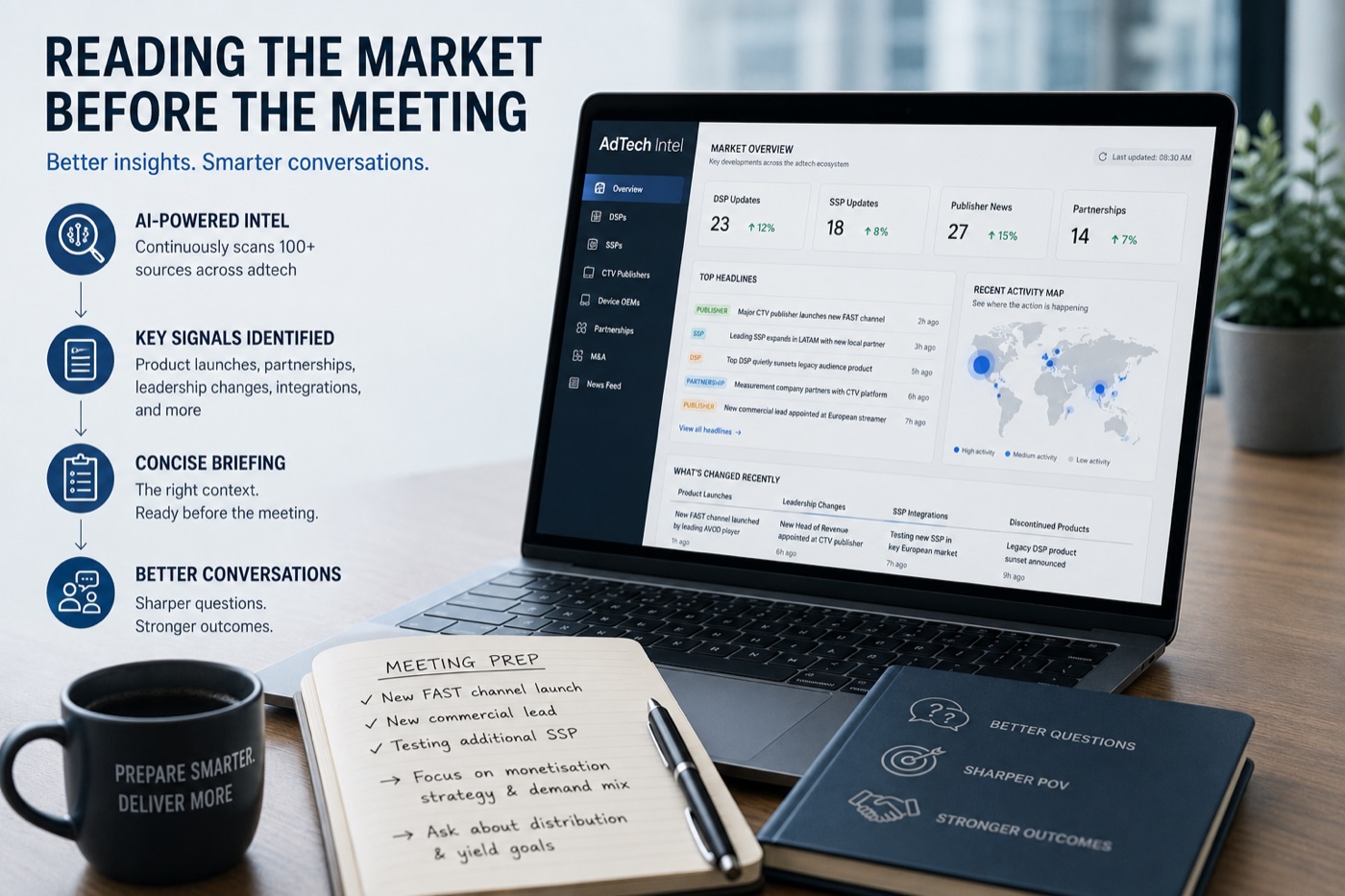
For years, preparing for a business development conversation meant spending several hours researching the prospect, reviewing recent news, looking at what competitors were doing, and trying to understand what might be on the other person's mind before walking into the meeting. In reality, much of that preparation either did not happen or was rushed late the night before.
That is becoming increasingly difficult to justify.
AI has not simply made research faster. It has changed the nature of the task itself. Instead of someone manually scanning trade publications, company announcements and industry websites, an AI system can continuously identify and organise the signals that matter. It can highlight what a publisher has just launched, which SSP a competitor has moved to, which partnership has been announced, or what a DSP has quietly discontinued.
The result should not be another collection of links waiting to be read. It should be a concise briefing that is ready before the meeting begins.
DigiAdapt's AdTech Intel page is one example of this approach in practice. It brings together news and developments across DSPs, SSPs, CTV publishers and device manufacturers, with the information refreshed automatically rather than assembled manually. It was created because the alternative, asking one person to track developments across dozens of sources every week, simply does not scale for a lean advisory business.
The tool itself is not the product. It is part of the infrastructure the business needs in order to remain current without building a dedicated research team.
The same principle applies directly to preparing for a deal conversation. Before speaking with a publisher, brand or technology platform, the most useful question is no longer simply, "What do I already know about them?" It is, "What has changed recently that they would reasonably expect me to know?"
Take the example of a CTV publisher looking to expand its programmatic revenue. A traditional briefing might cover its audience, content portfolio and commercial model. An AI assisted briefing could go further by identifying that the publisher had recently launched a new FAST channel, appointed a new commercial lead and started testing an additional SSP in one of its key markets.
That information immediately changes the meeting. Instead of spending the first twenty minutes asking broad discovery questions, the conversation can begin with a more informed hypothesis. The new channel suggests that distribution and monetisation are becoming more important. The leadership appointment may point to a change in commercial priorities. The SSP test could indicate dissatisfaction with current demand, an effort to improve yield, or a desire to create more competition within the supply stack.
Not every signal will prove significant, but arriving with that context allows the discussion to move more quickly towards the real commercial issue. The value is not that AI found three pieces of news. The value is that experience can turn those signals into better questions, a sharper point of view and a more relevant conversation.
This is where the real benefit of AI becomes clear. It turns what used to be a broad research exercise into a focused five minute task. Funding news, leadership changes, product launches, failed partnerships and competitor integrations can all be surfaced quickly, reducing the likelihood that useful preparation is postponed or skipped when time is limited.
None of this replaces judgement. Understanding which developments genuinely matter, and distinguishing a meaningful strategic shift from routine operational activity, remains the advisory work. That is still where experience, context and commercial judgement are essential.
What has changed is the speed at which the raw material for that judgement becomes available. Information that once took several hours to collect can now be organised in minutes. This affects not only how research is done, but how consistently people prepare before important conversations.
Lean advisory businesses are likely to feel this shift before the large consulting firms. In a senior, specialist practice, the founder's or adviser's time is usually the main constraint. AI does not replace the judgement being sold. It simply reduces the amount of the working week that disappears into the research required to support it.