Ask most companies whether they have adopted AI and the answer is now almost always yes. McKinsey's latest Global Survey on AI found that 88 per cent of respondents said their organisations were using AI in at least one business function, while Salesforce's 2026 State of Marketing report found that 75 per cent of marketers were turning to AI to help meet growing demands for personalised content. Adoption, in other words, is no longer the interesting question. The more useful question is what happens after adoption.
McKinsey found that only around 6 per cent of respondents qualified as AI high performers. These were organisations reporting significant value from AI and attributing at least 5 per cent of earnings before interest and tax to its use. Most organisations were still experimenting, piloting or applying AI within isolated parts of the business rather than changing how work was performed across the organisation. This is the difference between having access to AI and rebuilding a task around it.
For many people, AI still sits beside the existing workflow. It is a chatbot open in another tab, used to draft an email, summarise a document or provide a starting point for a presentation. That can save time, but the underlying process remains largely unchanged. The productivity data reflects this. Research published by the Federal Reserve Bank of St. Louis found that workers using generative AI reported saving an average of 5.4 per cent of their working hours. For someone working a 40 hour week, that is approximately 2.2 hours. Useful, certainly, but not yet transformational.
A separate study from the London School of Economics and Protiviti found that professionals using AI reported saving an average of 7.5 hours a week, equivalent to almost one working day and an estimated £14,000 in annual productivity gains per employee. The studies used different samples and methodologies, so they should not be treated as a direct comparison. Together, however, they point towards the same conclusion: the value of AI depends heavily on how consistently and deliberately it is incorporated into work.
The real opportunity is not simply to use AI to complete fragments of an existing process more quickly. It is to identify a recurring task and redesign it so that much of the process can run without being reconstructed each time. I saw this clearly during my time at mediasmart while working with SSP partners.
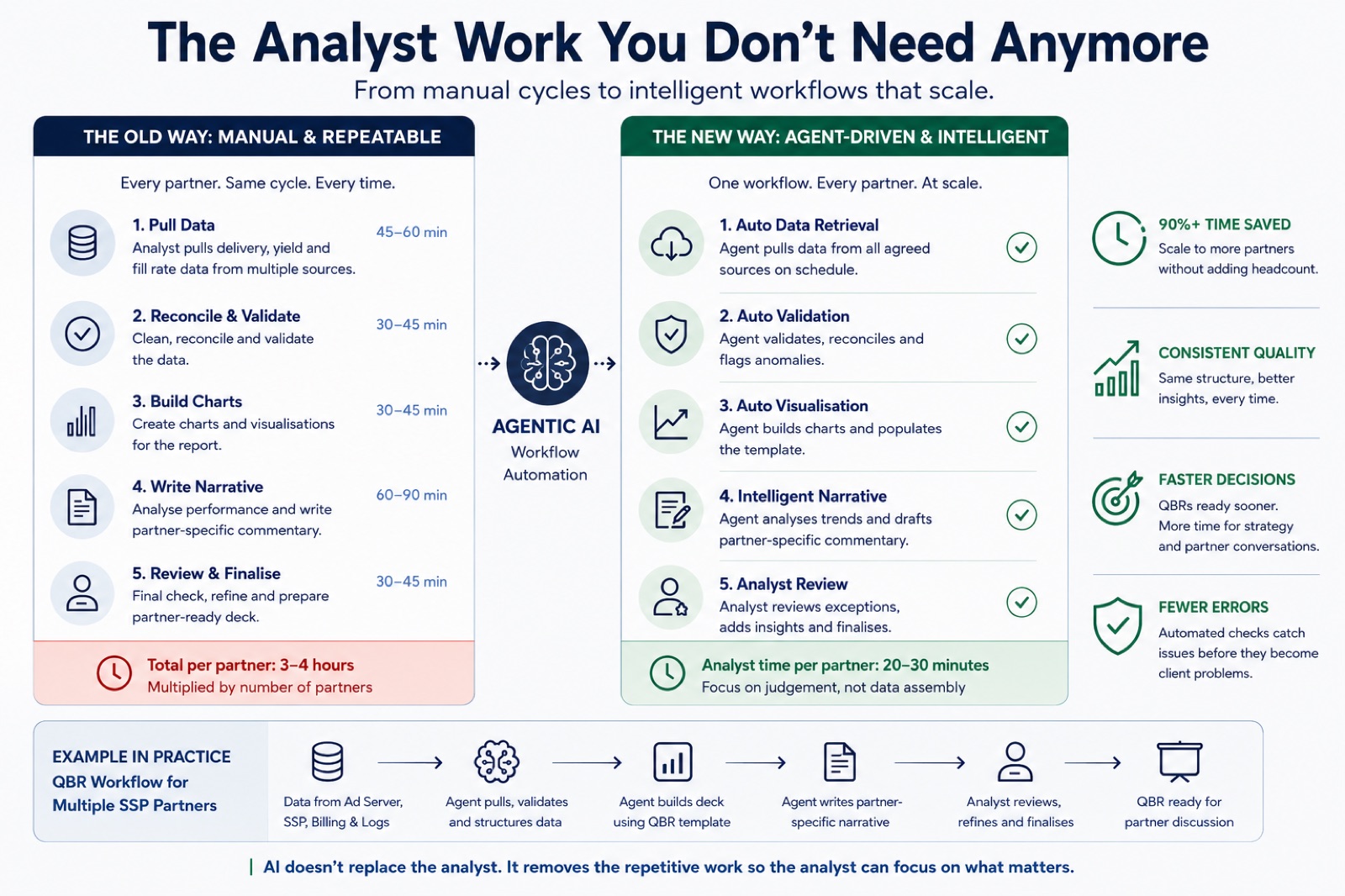
A quarterly business review would typically begin with someone pulling delivery, yield and fill rate data for one partner, reconciling the numbers, building the charts and then writing a narrative that a partner facing audience could act upon. Once the first presentation was complete, the sensible next step was to turn it into a template. The structure, chart types and broad narrative flow could then be reused for the next partner.
The template, however, only solved part of the problem. Someone still had to retrieve the next partner's data, validate it, populate the presentation and rewrite the narrative around what those numbers actually showed. The second partner was unlikely to have the same story as the first. One might have a fill rate problem, another might be delivering volume but at a lower yield, while a third might be performing well overall but underperforming in one strategically important market. Each additional SSP therefore meant running essentially the same manual cycle again, even when the new cycle began with a better structure.
This is where agentic AI changes the process. Once the reporting structure, data sources and narrative rules have been defined, an agent can execute much of the recurring work. It can retrieve each partner's data, populate the agreed structure, identify material changes and draft a narrative based on that partner's actual performance. It is not simply copying the first partner's story and replacing the numbers. It is examining what is different in the next dataset and building the first version of the commentary around those differences.
Whether the business has two SSP partners or ten, the additional effort required for each QBR can fall significantly. The work that once required someone to repeatedly assemble the same report can become a largely automated workflow, with the analyst concentrating on exceptions, interpretation and the commercial conversation.
The same pattern applies to something less visible but equally important: campaign quality assurance before launch. Checking that creative specifications, flight dates, budgets and targeting settings match the signed insertion order across every line item often means working through a spreadsheet manually before a campaign goes live. It is repetitive and detailed work, but mistakes can lead to missed delivery, incorrect targeting or an uncomfortable make good conversation with the client.
An agent can perform those checks automatically whenever a campaign approaches launch. It can compare the insertion order with the configured line items, flag inconsistencies and route exceptions to the right person before the campaign goes live. The value is not that AI can read a spreadsheet. The value is that the check no longer depends on someone remembering to repeat the same process at the right moment for every campaign.
None of this removes the judgement that matters. Someone still has to decide what the QBR should measure, which variations deserve attention and when a partner's numbers are revealing something the standard template was not designed to recognise. Someone must define the campaign rules, decide which discrepancies are material and understand when an exception is commercially justified. That remains the analyst's role.
What begins to disappear is the work around that judgement: retrieving the same information, rebuilding the same structure, repeating the same checks and producing the first version of the same analysis every time the partner count increases or the campaign list becomes longer.
This is the shift hidden beneath the adoption numbers.
Most companies now have AI, but far fewer have taken a recurring process and redesigned it so that an agent can run most of it from beginning to end. McKinsey's research suggests that workflow redesign is one of the strongest factors associated with organisations capturing meaningful value from AI. Its high performing organisations were nearly three times more likely than others to say they had fundamentally redesigned individual workflows.
The opportunity is therefore not to remove analysts. It is to remove the analyst work that no longer requires an analyst. The organisations that understand this will not measure AI adoption by the number of employees with access to a chatbot. They will measure it by the number of repetitive processes that no longer need to begin from scratch.