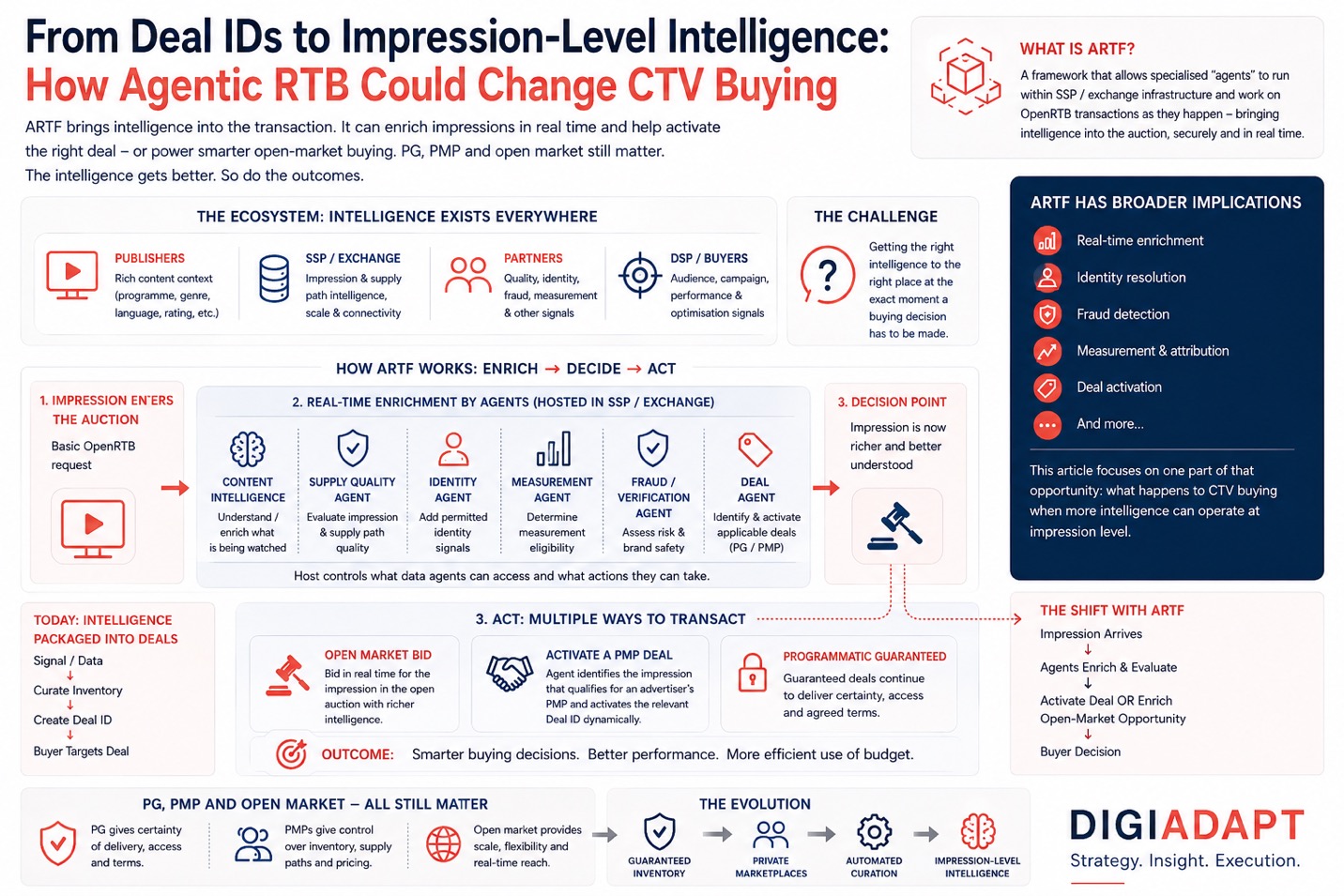
I have been looking closely at the IAB Tech Lab's Agentic Real-Time Framework (ARTF) recently. What catches my attention isn't the trendy "agentic" terminology—ad tech has seen plenty of buzzwords come and go over the years. What truly interests me is what it could practically change in the way we buy and curate Connected TV (CTV).
At a foundational level, ARTF is a standard that allows specialised services—or "agents"—to run natively within the host infrastructure of an SSP, DSP, exchange, or programmatic platform, executing on OpenRTB transactions in real time as they occur. Instead of requiring every data, enrichment, or decisioning partner to make an external network hop in the critical auction path, these services operate directly inside the host environment. The host maintains strict governance, controlling what information agents can access and what actions they are permitted to take.
Think of it as bringing intelligence directly into the transaction, rather than continuously sending the transaction out across disparate systems in search of intelligence.
While ARTF has broad industry implications across identity, fraud detection, measurement, and deal activation, I want to focus deliberately on one pivotal opportunity: what happens to CTV buying and curation when deep intelligence operates natively at the impression level.
The Core Programmatic Dilemma in CTV
A recurring challenge in programmatic advertising is that the data required to make an optimal buying decision is deeply fragmented across the ecosystem:
- The publisher provides rich contextual detail about the programming, genre, language, and content rating.
- The SSP understands technical supply characteristics, device parameters, and path efficiency.
- Measurement partners require specific signals (like raw IP or household graphs) to attribute outcomes.
- The DSP and buyer hold audience segments, campaign goals, and historical performance insights.
The central challenge has always been getting the right intelligence to the right place at the exact millisecond a buying decision is made. In CTV, we have traditionally resolved this fragmentation by packaging that intelligence directly into inventory buckets beforehand.
If an advertiser requires guaranteed delivery against premium shows, Programmatic Guaranteed (PG) provides absolute certainty over price and volume. If they need greater flexibility, a Private Marketplace (PMP) packages inventory around specific content or supply characteristics. The open market, meanwhile, offers unmatched scale and liquidity.
Each model solves a specific operational need: PG delivers certainty, PMP provides access control, and the open market offers reach. However, this raises a fundamental question: do we really need to negotiate and configure a static deal every time we want to evaluate an impression with better intelligence?
Real-World Lessons from CTV Product Building
When building CTV products, we quickly realized that effective supply curation goes far deeper than simply whitelisting publishers or selecting high-level genres. In practice, supply partners helped us identify granular characteristics that consistently drove superior outcomes—sometimes drilling down into specific ISP routing or network connectivity traits that offered cleaner, more efficient delivery.
Measurement was another defining factor. For performance-driven CTV campaigns, having unmasked IP information was vital whenever Mobile Measurement Partner (MMP) attribution relied on household-level matching. Consequently, two impressions that looked virtually identical from a surface media standpoint held completely different values for the buyer: one was high-quality content that was difficult to attribute, while the other carried the exact technical signals required for verifiable performance.
Historically, capturing this nuanced value required manual supply relationships, custom integrations, or bespoke curated deals. ARTF fundamentally changes where that intelligence can live and execute.
Why the SSP Layer Is the Ideal Aggregation Point
For CTV, the SSP is where this architecture becomes particularly powerful. While direct DSP-to-publisher integrations exist, they remain concentrated among a small tier of mega-publishers. For the broader market, the SSP remains the natural aggregation point where buyer demand meets multi-publisher supply.
This is no longer purely theoretical. Major exchange partners involved in developing ARTF (such as Index Exchange) have already discussed live container deployments operating directly within exchange infrastructure. This provides a clear operational blueprint: rather than requiring every individual publisher to deploy and maintain custom tech stacks, containerized intelligence can execute seamlessly at the exchange layer where inventory naturally aggregates.
In an ARTF-enabled exchange, publishers supply inventory with first-party metadata, while specialized in-host agents evaluate and enrich impressions under strict host governance:
- A content intelligence agent can parse and classify granular programme and genre signals.
- A supply-quality agent can verify technical parameters and path integrity.
- A measurement agent can confirm the presence of required attribution parameters.
The buyer doesn't necessarily need access to every piece of raw underlying data—what they need is actionable intelligence to make a smarter real-time bid.
From Curating Deals to Curating Impressions
Traditional curation begins with a static request: "Please package inventory that meets these criteria into a Deal ID." ARTF introduces the ability to move that intelligence directly into the live auction stream. The core question shifts from asking "What inventory bucket is this?" to asking:
"Does this individual impression possess the specific content, supply, and measurement characteristics I care about right now?"
This subtlety represents a profound architectural shift: it moves the fundamental unit of curation from the deal to the individual impression.
Consider a strategy-game advertiser whose highest-converting audience indexes heavily into military history and geopolitics documentaries. Traditionally, reaching that audience meant negotiating direct deals or setting up curated PMPs across pre-identified publisher catalogs. If guaranteed volume is required, PG remains a sound choice. But if reliable content and quality intelligence can execute at auction time, the buyer no longer needs to identify and pre-package every relevant publisher source beforehand.
When an impression enters the auction, its characteristics are evaluated dynamically:
- Is the content contextually relevant (e.g., a history documentary)?
- Does the supply path satisfy strict quality and fraud benchmarks?
- Are the technical signals present to measure down-funnel performance?
- Is the clearing price aligned with expected ROI?
Rather than pre-selecting static buckets of inventory, buyers can dynamically evaluate the true value of individual impressions as they appear.
Dynamic Deals: Bridging Curation and Open Market
Impression-level intelligence does not imply that all transactions will abandon private marketplaces and move into the open exchange. Crucially, in-stream intelligence can make existing deals far more dynamic.
If an advertiser holds a curated PMP for premium inventory, an in-stream agent can identify when an incoming impression matches the precise content and quality criteria of that agreement, instantly activating the deal. This eliminates the false dichotomy between Deal IDs and open-market bidding, revealing an important architectural distinction:
The intelligence used to evaluate an impression is completely decoupled from the commercial mechanism used to transact it.
Intelligence establishes what an impression is, verifies its quality, and calculates its value. The commercial mechanism—whether Programmatic Guaranteed, a PMP, or the open market—simply dictates the commercial terms under which buyer and seller choose to execute.
Why FAST Accelerates This Shift
Free Ad-Supported Streaming TV (FAST) represents the ideal proving ground for agentic RTB. FAST environments are inherently thematic—clustering naturally around true crime, food, anime, live sports, and niche news. This provides rich contextual signals, but it also creates severe supply fragmentation.
If every buyer seeking contextual alignment has to negotiate and maintain individual deals across dozens of niche FAST channels, the programmatic ecosystem loses its primary advantage: automated scalability. By enabling content intelligence to operate directly in the transaction stream, buyers can identify relevant contextual moments across fragmented supply in real time, bidding via the open market or triggering automated private deals as appropriate.
The Evolution of CTV Curation
The role of curation is undergoing a natural progression:
Guaranteed Inventory → Private Marketplaces → Automated Curation → Impression-Level Intelligence
Earlier buying models primarily dictated what you could access and how you transacted. Impression-level intelligence directly informs what you should buy and why it is worth the bid.
The ultimate promise of ARTF in Connected TV is not about eliminating deals—it is about ensuring that buyers don't need to construct a new Deal ID every time they want to make an intelligent decision. And when a deal is required, that deal becomes significantly smarter.