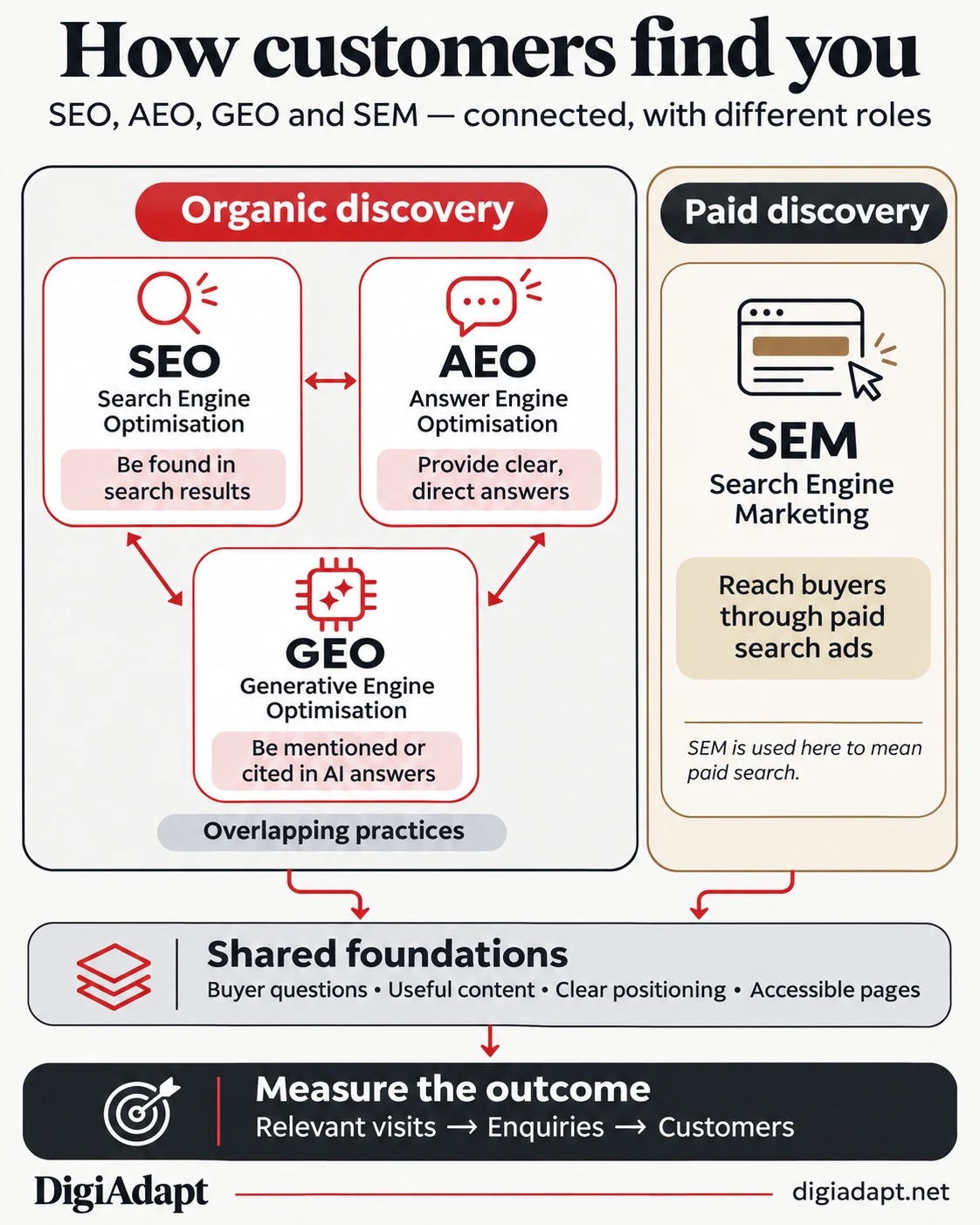
The foundations still matter
Google's own guidance says existing SEO practices remain relevant to AI Overviews and AI Mode. There's no special schema or additional technical requirement for those features. Google's guidance
Before you buy a GEO package, ask what it changes on your website, in your content and in how results are measured.
A new acronym should come with a clear explanation of the work.
Start with the questions your customers ask
A potential customer might ask:
- "Which supplier would suit a business our size?"
- "How does this service compare with the alternatives?"
- "What should I check before choosing?"
Your content should help them make those decisions. Explain who your service suits, what an engagement involves, what affects the price and what results you can support with evidence.
Publish a customer result you can substantiate. Explain a comparison you've actually tested. Answer a question your team hears every week.
Give people a reason to trust and reference you.
For my own business, DigiAdapt, I would test questions such as "Who can help a publisher improve programmatic revenue?" and "What should a business check before investing in AI search visibility?"
Those reflect the work I want potential clients to find me for. Asking an AI to describe DigiAdapt by name tests something different: whether it knows the business already.
If you publish videos or social posts, the same discipline applies
The thumbnail, title, description and captions deserve as much attention as the upload itself.
They do different jobs. A thumbnail helps someone decide whether to watch. A descriptive title and accurate metadata explain what the content covers. Captions and transcripts make the spoken information accessible in text.
Google's video guidance specifically covers accessible thumbnails, dedicated watch pages and consistent video metadata. These support video discovery; they aren't a guarantee of inclusion in an AI answer. Google's video guidance
My practical checklist would be:
- Use a thumbnail that makes an accurate promise. Make the subject clear and the text readable on a phone.
- Give the video a specific title. "How publishers can assess CTV demand partners" tells people more than "The future of advertising."
- Write a useful description. Explain the question answered, who is speaking and where viewers can find supporting information.
- Check captions and transcripts. Correct names, technical terms and figures. Add chapters where they help people find an answer.
- Make social posts understandable on their own. Put the central point in the post text, with relevant context and sources. Avoid leaving the entire explanation inside an image.
- Give substantial work a home on your website. A page containing the video, a concise summary, a transcript and supporting links gives you a reference you can maintain.
For AEO and GEO, I would treat this as making your material easier to understand and use wherever it is accessible. I would not promise that a better thumbnail, more hashtags or extra metadata will earn an AI citation.
Access varies across platforms. Publishing on a social network does not mean every search engine or AI assistant can retrieve the post.
If you are a publisher losing search traffic, start with the cause
For a publisher, being cited without receiving a visit may offer little immediate compensation for the cost of producing the journalism.
But before attributing every decline to AI, examine what changed.
Which pages and queries lost traffic? Did rankings fall, impressions decline, or click-through rates drop while positions remained broadly stable? Were there indexing problems, seasonal changes or shifts in demand?
Those patterns help narrow the diagnosis. They do not, by themselves, prove AI caused the loss.
Then build a response around both discovery and revenue.
Give readers reasons to visit and return.
Original reporting, specialist analysis, useful databases, tools and trusted voices give readers reasons to seek you out directly. Decide which of those strengths your publication can sustain.
Build direct relationships.
Use relevant articles to introduce newsletters, registrations, memberships or subscriptions. Explain what readers will receive and why it is worth returning for.
A newsletter signup is useful when it leads to an engaged reader. Measure repeat visits, subscription conversion and retention alongside acquisition.
Give each piece of content a commercial purpose.
Some stories attract new readers. Others deepen engagement, support sponsorship or persuade someone to subscribe. Review performance against those roles.
For an advertising-funded publisher, also look at revenue per visit and the reader experience. Adding more ads to compensate for fewer visits can make the remaining audience less willing to return.
Decide deliberately what AI systems can access
There are several choices here: allowing discovery, restricting training, protecting premium content and charging for access.
They are not interchangeable.
OpenAI provides separate controls for its search crawler and training crawler. A publisher can allow OAI-SearchBot while blocking GPTBot. OpenAI's crawler guidance
Google's controls work differently. Googlebot governs access for Search, including its AI features. Snippet controls can limit what appears, while Google-Extended controls certain other AI uses. Don't assume blocking a training crawler also removes content from AI search answers. Google's AI search controls
Blocking crawlers is an access decision, not a traffic recovery strategy. It does not undo previous collection or guarantee protection against bots that ignore instructions. Premium content needs appropriate access controls as well.
The question I would ask is: what value do we receive in return for access, and what are we prepared to make available?
Subscriptions and licensing are different opportunities
One approach is to make selected content discoverable while reserving deeper reporting, data or tools for subscribers. Publishers should implement paywalls and search markup carefully; Google provides specific guidance for subscription content. Google's paywall guidance
Another approach is to use AI inside the subscription product.
The Financial Times' Ask FT lets Professional subscribers ask questions and retrieve answers grounded in FT reporting. It illustrates how an archive can become a useful research service. It does not establish that adding a chatbot will automatically increase subscriptions. FT's account of Ask FT
For a specialist publisher, the equivalent might be helping subscribers search industry research, compare past developments or find relevant reporting faster. Start with a reader problem and test whether solving it improves usage, conversion or retention.
Licensing and paid crawler access are a separate revenue route. Cloudflare's Pay Per Crawl, currently described as a closed beta, enables participating publishers to charge for AI crawler access. That is an option to evaluate, not revenue to assume will replace lost advertising income. Cloudflare's documentation
A publisher could combine these approaches: open discovery content, protected subscriber products and selective commercial access.
Spend an hour on a first-pass review
Choose five real customer or reader questions and your three most important pages.
- Check whether you appear. Ask the questions in the AI platforms relevant to your audience. Record mentions, citations, competitors and inaccuracies.
- Check whether your positioning is clear. Can someone quickly understand what you offer, who it is for and why they should trust you?
- Check whether your content answers the questions. Include relevant videos and social posts. Review titles, descriptions, captions and the evidence behind your answers.
- Review access settings. Ask whoever manages your website to explain what search engines and AI crawlers can access. Make sure the settings match your commercial intentions.
- Check the next step. Can an interested visitor enquire, buy, register or subscribe? Is there a clear reason to do so?
Use the hour to identify gaps. Fixing them may take longer.
Repeat the AI questions several times, keeping the wording consistent and recording the date and platform. One screenshot tells you very little.
Measure the result that matters to your business
For a service business, that could be qualified enquiries. For a retailer, purchases. For a publisher, engaged readers, advertising revenue, subscriptions or licensing income.
Track identifiable AI referrals and what those visitors do. Where appropriate, ask customers how they heard about you. Neither gives complete attribution, but together they can improve your understanding.
For paid experiments, apply the same discipline: a clear audience, a limited budget and an agreed measure of success.
You don't need to solve every channel this month. Start with the questions that matter, improve the content that answers them and decide how discovery should contribute to revenue.
At DigiAdapt, I help publishers, platforms and brands connect digital visibility and advertising activity to commercial goals.
Can the right person find you, understand your value and take the next step? And if your content is the product, are you capturing enough of that value?
If you want to discuss what you find, bring your website and five customer or reader questions to a 30-minute call with DigiAdapt. We can talk through the gaps and where to start.